
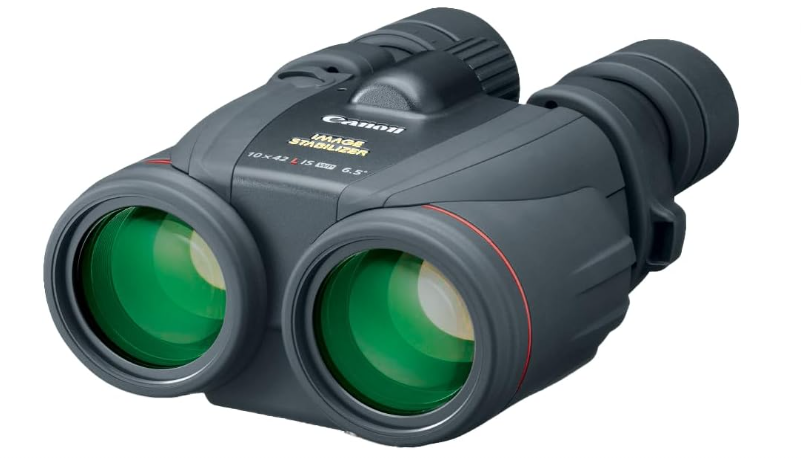
Today’s post is about the best marine binoculars. Out on the open water, nothing ever really stands still. The sea is constantly shifting, the light changes by the minute, and distant shapes on the horizon can appear and disappear before you’re even sure what you saw. In those moments, your eyes alone are not always enough. You need something that brings the world closer with clarity you can trust, even when the boat is moving, the wind is picking up, or the light is fading.
That’s exactly where the best marine binoculars prove their value. They are built not just to magnify what’s far away, but to keep the view steady, bright, and reliable when everything around you is in motion. At the end of this article, we hope you’ll have found a pair that feels right for your next expedition: something dependable enough to travel with you wherever the water leads.
Best Marine Binoculars
1) Bushnell Marine 7×50 Binoculars
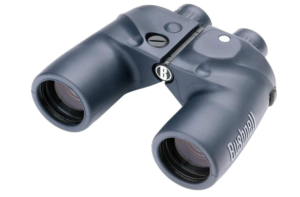
The Bushnell Marine 7×50 Binoculars with Compass deliver dependable optical performance in demanding marine environments. They combine rugged durability with practical navigation features that go beyond standard binoculars.
The binoculars are built with a classic Porro prism system for excellent depth perception. This is an essential advantage when judging distances across moving water. The individual focus system ensures precise adjustments for each eye, making them especially useful for long-distance viewing.
With large 50mm objective lenses and fully multi-coated optics, these binoculars produce bright, sharp images even in low-light conditions such as early mornings or late evenings on the water. They also provide a degree of protection against harmful UV rays, adding an extra layer of visual comfort.
What truly sets these binoculars apart is their built-in navigation functionality. The integrated analog compass and illuminated range-finding reticle allow you to measure distance and direction accurately. This an invaluable feature for boating, fishing, and sailing, making them qualify as one of the best marine binoculars.
The binoculars are truly made for unforgiving marine conditions. They are nitrogen-purged and O-ring sealed, ensuring they remain fully waterproof and fogproof. The thick rubber armor adds another level of protection, guarding against impacts and resisting corrosion from saltwater exposure.
Pros
- Excellent brightness and clarity in low-light marine environments
- Integrated compass and reticle for navigation and distance measurement
- Rugged, waterproof, and fogproof construction
- Superior depth perception thanks to Porro prism design
- Comfortable and precise individual focusing system
Cons
- Individual focus may be less convenient for quick adjustments
2) Steiner Optics Commander 7×50 Binoculars
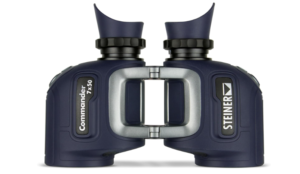
The Steiner Optics Commander 7×50 Binoculars stand at the pinnacle of marine optics, engineered for serious sailors, navigators, and offshore adventurers who demand uncompromising performance. They are made with German precision and designed specifically for life at sea. As one of the best marine binoculars, they combine exceptional optical clarity with rugged, battle-tested durability.
At the heart of their performance is Steiner’s proprietary Diamond Marine lens coating, which maximizes light transmission while reducing glare from reflective water surfaces. Paired with 7x magnification and large 50mm objective lenses, the binoculars deliver an impressively bright image with a massive exit pupil. These attributes guarantee a steady, clear view even in low-light conditions or on constantly moving water.
Another highlight is Steiner’s Sports-Auto-Focus system. Once adjusted to your eyes, the binoculars keep everything from about 20 yards to infinity in razor-sharp focus without the need for constant refocusing. This “set-and-forget” functionality is invaluable when you need one-handed operation, whether you’re steering a boat, adjusting sails, or holding onto railings in rough seas.
Durability is where the Commander truly earns its reputation. It is fashioned with a Makrolon polycarbonate chassis. The result? The binoculars are lightweight yet incredibly tough.
The floating prism system, supported by flexible silicone, absorbs shock from impacts, ensuring the optics stay aligned even under harsh conditions. Fully submersible up to 10 meters and nitrogen-pressure filled, they are completely waterproof and fog-proof, ready to perform in extreme marine environments.
The wide 145m field of view at 1000 meters provides a sweeping panoramic perspective, making it easier to scan the horizon for navigation hazards, coastlines, or other vessels. Steiner also includes a premium set of accessories, such as a hard case, floating strap, neoprene carrying strap, rain cover, and lens caps. Everything you need for protection and convenience on the water.
Pros
- Exceptional brightness and clarity, even in low-light marine conditions
- No need for constant refocusing thanks to Sports-Auto-Focus
- Extremely durable and impact-resistant construction
- Fully waterproof, fog-proof, and submersible
- Wide field of view ideal for navigation and scanning
- Premium accessories included
- Industry-leading lifetime warranty
Cons
- Premium price point compared to standard marine binoculars
- Auto-focus system may take time to get used to for new users
3) Fujifilm Fujinon Mariner 7×50 Binoculars
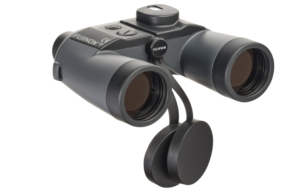
Next, we have the Fujifilm Mariner 7×50 Binoculars. They are dependable and thoughtfully designed for marine enthusiasts seeking high performance without excessive weight or cost. Thanks to Fujifilm’s renowned optical expertise, these binoculars strike an excellent balance between durability, clarity, and practical onboard functionality.
Optically, the Mariner XL delivers bright and crisp images because of the fully coated Fujinon lenses that boost light transmission and minimize glare. The classic 7×50 configuration ensures a steady image and excellent brightness, even in low-light conditions such as dawn, dusk, or overcast days at sea.
With an impressive 18mm eye relief, these binoculars are particularly comfortable for extended viewing sessions and ideal for users who wear glasses.
Additionally, they have an integrated compass and range-finding reticle, visible through the left eyepiece. This allows for quick and accurate navigation readings without taking your eyes off the subject. For nighttime use, Fujifilm incorporates an energy-efficient LED nightlight, ensuring the compass remains visible in low-light conditions.
The clever placement of the control pushbutton and battery in the right barrel minimizes electrical interference, preserving the compass’s accuracy, an often-overlooked but critical detail in marine navigation.
Durability and safety are also key strengths of the Mariner XL. These binoculars are fully waterproof, making them well-suited for harsh marine environments. Moreover, the included closed-cell foam flotation strap ensures that if they are accidentally dropped overboard, they will remain afloat for easy retrieval.
Pros
- Bright, clear optics with excellent low-light performance
- Integrated compass and reticle for navigation
- LED illumination for night use
- Comfortable long eye relief, great for eyeglass wearers
- Lightweight compared to many marine binoculars in its class
- Floats if dropped overboard
- Strong value for the price
Cons
- Fully coated optics (not multi-coated) may offer slightly less contrast than premium models
- Built-in electronics require battery maintenance
4) Hooway 7×50 Marine Binoculars
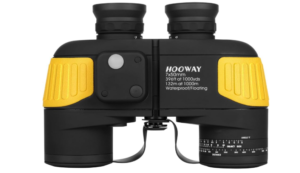
Another contender for the best marine binoculars is the Hooway 7×50 Marine Binoculars.
With a classic 7x magnification paired with large 50mm objective lenses, they provide a steady and bright viewing experience. This is great for use on moving water. The generous 22mm eye relief ensures comfortable viewing, even for eyeglass wearers, while the 6.8mm exit pupil enhances brightness in low-light conditions. A wide field of view (396 feet at 1000 yards / 132 meters at 1000 meters) makes it easy to scan the horizon for landmarks, vessels, or wildlife.
Optics-wise, the binoculars are equipped with a Porro prism system that enhances depth perception and delivers a wider viewing angle. The use of BAK4 prisms combined with fully multi-coated lenses ensures bright, crisp images with improved light transmission and clarity. This makes them well-suited for both daytime and low-light marine environments.
The Hooway 7×50 are made for any condition. They are completely waterproof and nitrogen-purged to prevent internal fogging. They are also designed to float, adding an extra layer of security if accidentally dropped overboard. The rugged, non-slip rubber armor provides a firm grip and absorbs shocks, ensuring durability even in rough conditions.
For added functionality, these binoculars feature an illuminated built-in compass for direction finding, along with an internal rangefinder that helps estimate the distance and size of objects. A tripod adapter fitting is also included, allowing for hands-free, stable viewing during extended observation sessions. All these features cement the Hooway as one of the best marine binoculars.
Pros
- Bright, clear images with wide field of view
- Excellent value for money
- Built-in compass and rangefinder for navigation
- Fully waterproof, fog-proof, and floats in water
- Comfortable eye relief, suitable for eyeglass wearers
- Durable, non-slip design with tripod compatibility
Cons
- Optical quality not on par with premium marine brands
- Compass illumination requires battery use
5) Steiner Military-Marine 8×30 Binoculars
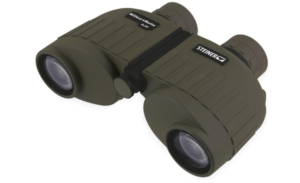
Another Steiner product that makes the cut is the Military-Marine 8×30. These binoculars are tailored around a military-grade Makrolon housing. This ensuresoutstanding strength while remaining lightweight and easy to handle. This polycarbonate chassis can withstand up to 11 Gs of impact, making it highly resistant to shocks and rough handling.
The NBR Long Life rubber armoring enhances grip and durability, providing a non-slip, noise-dampening surface that resists oil, saltwater, and harsh weather. This is perfect for demanding outdoor conditions.
Steiner’s Sports-Auto-Focus system is a defining feature here. Once each eyepiece is adjusted to your vision, the binoculars maintain sharp focus from around 20 yards to infinity without the need for constant refocusing. This allows for quick target acquisition and effortless one-handed use. This is a perk whether you’re scanning the horizon, tracking movement, or operating in dynamic environments.
Despite the smaller 30mm objective lenses, the 8x magnification strikes a great balance between reach and stability. These binoculars still deliver impressive brightness and clarity in most lighting conditions, with the added benefit of a more compact and portable design. The image remains steady and easy to control, even during extended use or when observing from a moving platform.
Durability is further reinforced by Steiner’s floating prism system, which uses flexible silicone mounts to absorb shock and prevent internal misalignment. This ensures that even after drops or impacts, the optical system stays perfectly aligned and ready for use. This is a feature that truly sets Steiner apart in the optics world.
Pros
- Extremely rugged, military-grade construction
- Compact and lightweight compared to larger marine binoculars
- No need for constant refocusing
- Fast target acquisition and easy one-handed use
- Shock-resistant design maintains optical alignment
- Reliable performance in a variety of environments
Cons
- Smaller objective lenses limit low-light performance
6) BARSKA 7×50 Marine Binoculars
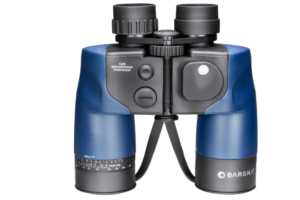
Investing in the BARSKA 7×50 Binoculars is one of the best decisions you can ever make. They are so versatile it’s like having many binoculars in one.
With 7x magnification and large 50mm objective lenses, these binoculars provide a steady and clear viewing experience, even when you’re on moving water. The inclusion of high-quality BAK-4 prisms enhances clarity, contrast, and light transmission, allowing you to enjoy bright, detailed views from sunrise to sunset.
A sfeature worth noting is the built-in navigation functionality. Equipped with an internal rangefinder and directional compass, these binoculars allow users to determine both distance and direction with ease.
The addition of variable zoom capability, inspired by Barska’s Gladiator series, adds another layer of versatility. With a smooth, easy-to-use zoom mechanism, you can quickly switch from a wide panoramic view to a closer, more detailed look. This essentially gives you multiple viewing options in one device.
The binoculars are nitrogen-purged and fully sealed, making them waterproof, fog-proof, and shockproof. The rugged, non-slip rubber armor ensures a secure grip even in wet conditions, while the floating neck strap adds an extra layer of safety by keeping the binoculars afloat if dropped overboard.
Comfort and usability are also well addressed. The ergonomic design makes them easy to handle during extended use, and the included neck strap allows for convenient carrying on long outings.
Pros
- Bright and stable image ideal for marine environments
- Integrated compass and rangefinder for navigation
- Variable zoom adds flexibility for different viewing needs
- Durable, all-weather construction
- Floats if dropped in water
- Comfortable and easy to handle
Cons
- Zoom feature can slightly reduce image stability at higher magnifications
Selecting the Best Marine Binoculars
Choosing the best marine binoculars requires a careful understanding of how the marine environment affects visibility, handling, and durability. Unlike land-based use, conditions at sea introduce constant motion, glare from water, humidity, and often low-light situations, so each feature plays a critical role in performance.
Magnification
Magnification is one of the most important starting points. In marine settings, lower magnification is actually more useful than higher power. This is why 7x magnification has become the industry standard. On a moving boat, higher magnifications such as 10x or more tend to amplify hand shake and vessel movement. This makes the image difficult to stabilize. A 7x binocular offers a much steadier and more usable view. This lets you scan the horizon and track moving objects comfortably.
Also Read:
Objective Lens Size
Closely related to magnification is the objective lens size. It determines how much light the binocular can gather. Marine binoculars are typically built with 50mm objective lenses because they deliver bright images even in dismal conditions such as dawn, dusk, fog, or overcast weather. This brightness is essential not only for viewing comfort but also for safety and navigation. Smaller lenses may be more compact, but they generally fall short in low-light marine environments.
Exit Pupil
Another critical concept when purchasing the best marine binoculars is the exit pupil. This refers to the amount of light reaching your eye. In a typical 7×50 marine binocular, the exit pupil is large and well-suited for low-light viewing:
507≈7.1\frac{50}{7} \approx 7.1
This large exit pupil makes the image appear brighter and easier to maintain, even if your hands are not perfectly steady. It also aligns well with how the human eye dilates in low-light conditions, making 7×50 binoculars especially effective at sea.
Waterproofing and Fogproofing
These are other non-negotiables to have in mind. Marine binoculars must be fully sealed to prevent water intrusion and internally purged with nitrogen or argon gas to avoid fogging from temperature changes. Saltwater is particularly corrosive, so without proper sealing and internal protection, even a high-quality binocular can quickly degrade.
Durability
Durability also plays a major role. Marine binoculars should be built with robust materials and covered in rubber armor to protect against drops, impacts, and constant exposure to moisture. A non-slip grip is especially important because wet hands and unstable footing are common on boats. The overall construction should inspire confidence that the binoculars can handle years of use in demanding environments.
Field of View
Field of view is another factor that becomes more important on water than on land. A wide field of view allows you to scan large areas quickly and track moving objects more effectively. Since marine observation often involves following vessels or spotting navigational markers, a broader view is far more practical than extreme magnification.
Navigation features such as a built-in compass and rangefinder can significantly enhance functionality, particularly for offshore use. A compass helps determine direction at a glance, often with illumination for nighttime visibility, while a rangefinder reticle allows you to estimate distances. T
Floatability
Floatability is a practical safety consideration that many buyers overlook when buying the best marine binoculars. Dropping binoculars into the water is not uncommon, and models designed to float. Those equipped with floating straps can prevent permanent loss. This feature can be especially valuable for casual boaters or those operating in rough conditions.
Optical Quality
Optical quality should not be underestimated, as it directly affects clarity, brightness, and color accuracy. Fully multi-coated lenses improve light transmission, while high-quality prisms such as BaK-4 enhance image sharpness. Anti-reflective coatings are also important in marine settings, where glare from sunlight reflecting off the water can otherwise reduce visibility.
Eye Relief and Comfort
Comfort and usability are equally important, particularly during extended viewing sessions. Features such as long eye relief benefit users who wear glasses, while adjustable eyecups and smooth focusing mechanisms improve overall ease of use. Although some marine binoculars use individual focus systems instead of central focus, they are often optimized for long-distance viewing where frequent adjustments are unnecessary.
Best Marine Binoculars FAQs
Are Marine Binoculars Waterproof?
Yes, the best marine binoculars are designed to be fully waterproof. They are usually sealed with O-rings and filled with nitrogen or argon gas to prevent internal fogging. Some models are built specifically to withstand water exposure and humid environments.
Are Marine Binoculars Good for Bird Watching or General Use?
Yes, they can be used for birdwatching or general viewing, especially in coastal areas. However, they are optimized for marine conditions, so they may feel heavier and less versatile compared to compact or birding binoculars.
What is the Difference Between Marine Binoculars and Regular Binoculars?
Marine binoculars are specifically built to handle water exposure, humidity, and constant motion. They typically feature lower magnification, larger lenses, waterproof construction, and sometimes built-in navigation tools. Regular binoculars are not always designed to withstand these conditions.
Do Marine Binoculars Require Maintenance?
Yes, basic maintenance helps extend their lifespan. After exposure to saltwater, it’s recommended to wipe them down with a damp cloth and store them in a dry place. Avoid exposing them to extreme heat or prolonged moisture when not in use.
Conclusion
Out on the water, clarity and reliability can make all the difference between simply seeing and truly navigating with confidence. That’s why the best marine binoculars are designed to deliver sharp, steady views even in challenging sea conditions, where glare, motion, and changing light are constant factors.
In the end, the ideal choice comes down to a balance of brightness, durability, and ease of use. We hope this review has been insightful and has helped you pick a model that ensures you’re always ready for safe and clear viewing at sea.
Read: 7 Best Zoom Binoculars